
Open cell or closed cell, chosen by the surface
Spray Foam Insulation in Iowa City, IA
Foam that air seals and insulates in one pass, used where it earns its cost.
- Free on-site estimates
- Written quotes that list R-value and depth for each area
- Air leaks sealed before new insulation covers them
What Spray Foam Does Differently
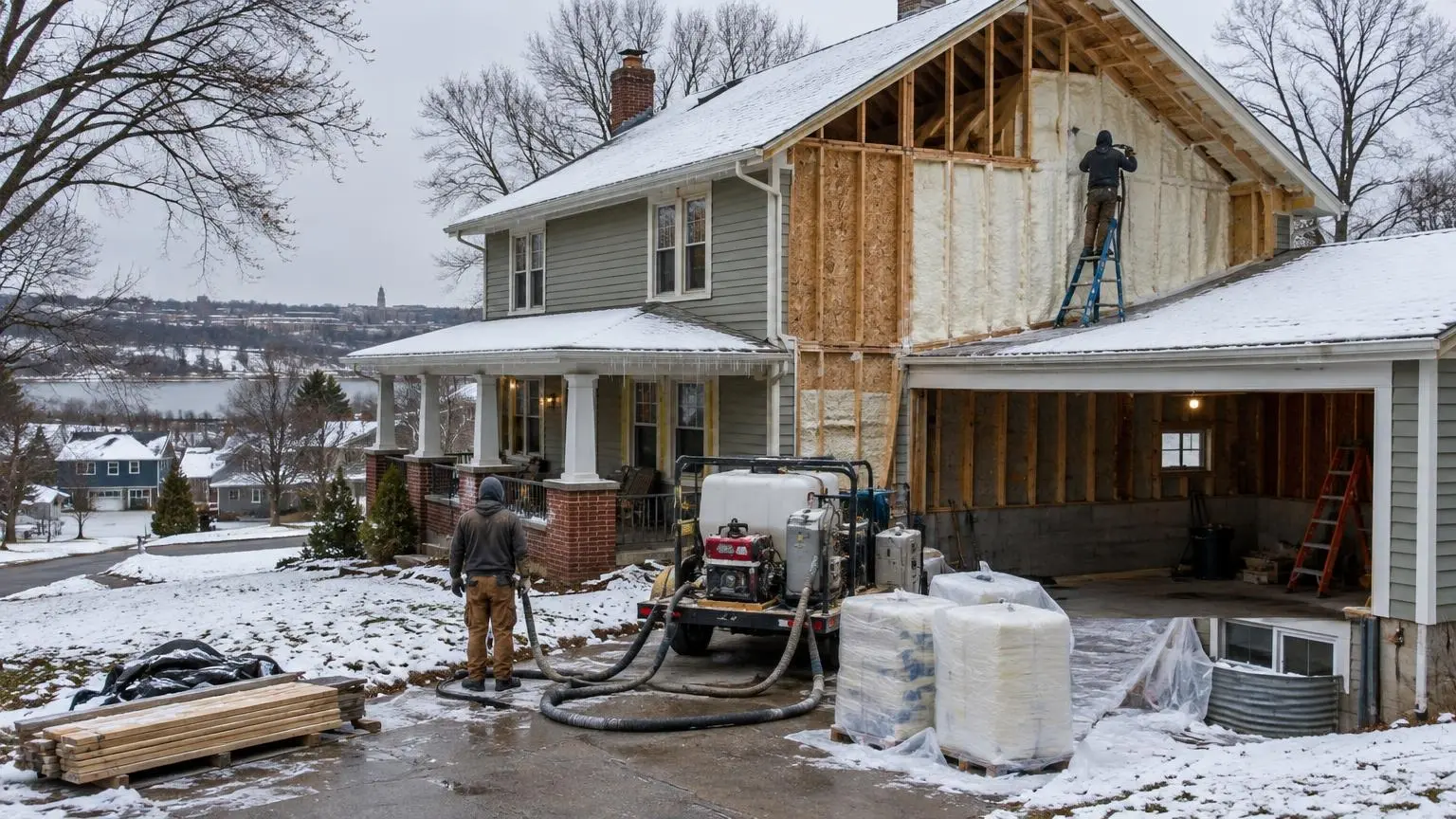
Spray foam insulation goes on as a liquid and expands to fill the cavity, so it seals air leaks and insulates at the same time. Batts and loose fill slow heat but let air move through them. In a Johnson County winter, a lot of heat leaves through gaps rather than through the insulation itself, which is why foam does so well on rim joists, around penetrations and in hard-to-reach cavities.
Closed cell
Closed-cell foam is rigid and dense, about R-5 to R-7 per inch. At enough thickness it also acts as a vapor retarder, so it is the right choice for basement walls, rim joists, crawl spaces and steel buildings that sweat. It adds some stiffness to the surface it is sprayed on. It costs more per square foot, roughly $3.00 to $5.00 installed according to HomeGuide.
Open cell
Open-cell foam is soft and spongy, about R-3.5 to R-3.7 per inch, and expands a lot, which makes it good at filling irregular framing. It lets vapor pass, so it belongs in dry spaces above grade: exterior wall cavities in new work or additions, rooflines and kneewalls. HomeGuide lists it at $1.50 to $3.50 per square foot. The Department of Energy says open-cell foam is not recommended below ground level, and we follow that.
Where foam makes the most sense in Iowa City
- Rim joists. The band of framing on top of the foundation leaks air in almost every basement we see. Closed-cell foam seals and insulates it in one step.
- Basement walls before finishing. Foam on bare concrete keeps warm, humid air off the cold wall.
- Bonus rooms and floors over garages. Foam fills joist bays and stops garage air from getting into the house.
- Cathedral ceilings and finished attics. Where there is no attic floor to fill, foam on the rafters is often the practical way to reach a useful R-value.
- Pole buildings and shops. Closed-cell foam on steel stops condensation and lets the building hold heat.
What we check first
We look for roof leaks, damp framing, frost on nail tips, mold and old knob-and-tube wiring before we recommend foam. Foam is hard to remove, so problems get fixed first. We also talk about ventilation: a house that gets much tighter may need a bath fan that actually vents outside, or a look at combustion air for an older furnace or water heater. Get a free estimate
What This Covers
The parts of a house and outbuilding where we use spray foam.
Rim joist sealing
Closed-cell foam on the band joist and sill plate around the full basement perimeter.
Basement and foundation walls
Closed-cell foam on bare concrete before framing, to the thickness the plan calls for.
Wall cavities in new work
Open-cell or closed-cell foam in open stud bays in additions, remodels and new homes.
Rooflines and kneewalls
Foam on the underside of the roof deck or in kneewall and slope cavities of finished attics.
Floors over garages
Foam in the joist bays under bonus rooms to block cold and garage fumes.
Outbuildings
Closed-cell foam on steel walls and roofs of shops and pole buildings.
Published Spray Foam Insulation Costs
| Job | Range and source |
|---|---|
| Spray foam, installed | $1.50 to $5.00 per sq ft (HomeGuide) |
| Open-cell / closed-cell | $1.50 to $3.50 / $3.00 to $5.00 per sq ft (HomeGuide) |
| About 1,000 sq ft | $1,500 to $5,000 (HomeGuide); $3,150 to $7,500 in an existing home (Fixr) |
| Existing walls / new construction | $3.15 to $7.50 / $2.75 to $6.50 per sq ft (Fixr) |
| All exterior walls | $4,000 to $10,000 (HomeGuide) |
| Whole house | $8,000 to $20,000 (HomeGuide); $10,000 to $30,000 (Fixr) |
| Typical job minimum | $1,000 to $2,000+ (HomeGuide) |
These are national ranges from HomeGuide's 2026 guide and Fixr's 2025 guide, not local quotes. Foam type, thickness, access and prep move the total, and small jobs often hit a minimum. Once we have measured, the number on your written estimate is what you pay.
How It Works
1. Walk-through
We look at the spaces you are worried about, measure them and check for moisture, leaks and wiring issues.
2. Written quote
You get foam type, thickness, R-value and price for each area, plus any alternatives we think are worth comparing.
3. Prep
We cover floors and belongings, mask what needs masking, set up ventilation and close off the work area.
4. Spray in passes
Foam goes on in the lift thickness the manufacturer specifies, and we check depth as we go.
5. Cure and clean up
The space ventilates for the stated re-entry time. We trim, clean up and walk you through the finished work.
Spray Foam Insulation Questions
Is spray foam worth it compared to fiberglass?
In some places, yes. Foam pays off where air leakage is the problem: rim joists, odd cavities, cathedral ceilings and steel. On a wide-open attic floor, sealing the leaks and then blowing in fiberglass or cellulose usually gets similar comfort for less money.
Can spray foam go over old insulation?
Not usually. Foam needs to stick to clean framing or sheathing to seal. Old batts in the way come out first. In an attic, we can often leave clean loose fill in place, seal the gaps around it and add more on top.
Does closed-cell foam stop water?
It resists water and vapor, but it is not a fix for a leak. If a basement wall seeps or a roof leaks, that needs to be repaired first, or the foam will just hide the problem.
How long does spray foam last?
Installed correctly and kept dry, foam does not settle or sag the way loose fill and batts can. It stays in place for the life of the framing it is attached to.
Spray Foam Insulation Service Areas
- Spray Foam Insulation in Iowa City, IA
- Spray Foam Insulation in Coralville, IA
- Spray Foam Insulation in North Liberty, IA
- Spray Foam Insulation in Tiffin, IA
- Spray Foam Insulation in Solon, IA
- Spray Foam Insulation in West Branch, IA
- Spray Foam Insulation in Kalona, IA
- Spray Foam Insulation in West Liberty, IA
- Spray Foam Insulation in Cedar Rapids, IA
- Spray Foam Insulation in Marion, IA
- Spray Foam Insulation in Hiawatha, IA
- Spray Foam Insulation in Ely, IA
- Spray Foam Insulation in Fairfax, IA
- Spray Foam Insulation in Mount Vernon, IA
- Spray Foam Insulation in Lisbon, IA
Get a Spray Foam Insulation Estimate
Tell us which spaces you want foamed and we will price them in writing.